How to Select a Fluid Bed Dryer for Efficient Industrial Drying
Wiki Article

Selecting the Right Fluid Bed Dryer for Your Manufacturing Requirements
Selecting industrial drying equipment is a decision that affects more than the moisture content of a finished product. It can influence manufacturing capacity, product consistency, operating expenses, cleaning procedures, and the ability to meet production specifications. A fluid bed dryer may be suitable for materials that can be fluidized by a controlled airflow, but not every model is appropriate for every application. A structured selection process helps manufacturers identify the technical requirements before comparing equipment designs or requesting quotations.
The JSK Engitech fluid bed dryer guide at jskengitech.com/fluid-bed-dryers-guide provides a starting point for learning about this drying technology. When moving from general research to equipment selection, buyers should evaluate the properties of their own materials and the demands of their manufacturing process instead of relying on capacity or performance descriptions alone.
Begin With the Characteristics of the Material
The product itself is one of the most important factors in determining whether a fluid bed dryer will perform effectively. Materials differ in particle size, density, shape, surface moisture, internal moisture, and tendency to form clusters. These characteristics affect how easily particles become suspended and how evenly the drying air moves through the bed.
For example, free-flowing granules may respond differently from fine cohesive powders. A product that becomes sticky as it warms may develop agglomerates during drying, while fragile particles may break down under unsuitable mechanical or aerodynamic conditions. The selection process should therefore start with representative material data.
Important Product Properties
- Initial moisture content: Establishes the moisture-removal requirement before the product reaches its target condition.
- Final moisture specification: Defines the endpoint required for storage, packaging, or the next process step.
- Particle size distribution: Influences fluidization behaviour and the likelihood of particle carryover.
- Bulk density: Helps determine the relationship between product loading, bed depth, and airflow requirements.
- Thermal sensitivity: Indicates whether product quality may be affected by temperature or exposure time.
- Flow and cohesion: Helps identify risks associated with clumping, uneven movement, or poor fluidization.
Where product behaviour is uncertain, testing under representative conditions may be necessary before finalising the design. Laboratory data and supplier recommendations should be reviewed in the context of the actual manufacturing process.
Determine the Required Production Capacity
Capacity should be evaluated using the amount of material that must be processed within a defined period. A nominal equipment capacity does not automatically represent the quantity of wet feed that can be processed in every application. Drying time, initial moisture, target moisture, loading method, discharge time, and cleaning requirements can all influence actual production throughput.
For batch systems, determine the required batch size and the expected number of batches per shift. Include loading, drying, cooling where necessary, discharge, and cleaning in the cycle-time estimate. For continuous systems, evaluate the required feed rate, residence time, and consistency of the incoming material.
Allow for Changes in Production Demand
Manufacturing requirements may change as product volumes increase or production schedules become more demanding. A dryer should meet present needs without creating unnecessary operating complexity. At the same time, buyers should understand whether the selected configuration can accommodate reasonable changes in throughput or product range.
Any anticipated expansion should be discussed with the equipment supplier. It is better to establish the limits of the proposed system than to assume that a machine designed for one operating condition will handle a substantially different workload without modification.
Compare Batch and Continuous Fluid Bed Drying
Fluid bed drying equipment can be configured for different production approaches. The choice between batch and continuous processing depends on product variation, production volume, changeover frequency, and process-control requirements.
Batch Processing
Batch systems process a defined quantity of material during each cycle. This arrangement can be useful when manufacturers produce several products, require controlled batch records, or need to inspect and release material between processing stages. However, overall productivity depends on the complete cycle, including loading, drying, discharge, and cleaning.
Continuous Processing
Continuous systems move material through a drying process at a controlled feed rate. They may be appropriate where production demand is relatively steady and the product characteristics support continuous fluidization. Maintaining consistent feed conditions and residence time becomes important when uniform output is required.
The choice should be based on the process as a whole. A continuous system is not automatically more economical for every manufacturer, and a batch system is not necessarily less efficient. Product changeovers, operator involvement, utilities, and maintenance all affect the overall comparison.
Evaluate Temperature and Airflow Controls
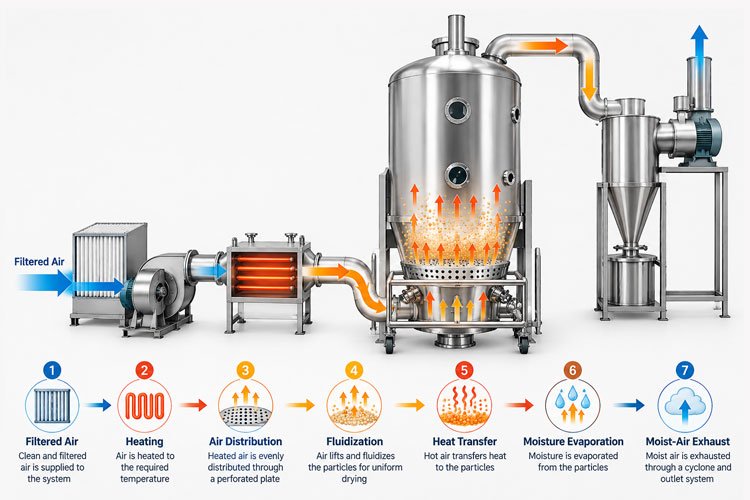
Temperature and airflow are central operating variables in fluid bed drying. Air must provide sufficient heat to remove moisture while remaining within the limits appropriate for the product. Airflow must create the intended fluidization pattern without causing excessive particle entrainment or unstable bed behaviour.
Ask the supplier how process temperature is measured, where sensors are positioned, how airflow is adjusted, and which operating conditions can be monitored or recorded. The required instrumentation depends on the application and the level of process control needed.
For heat-sensitive materials, the product temperature may differ from the incoming air temperature. Understanding this distinction is important when setting process limits and evaluating product quality. A controlled air temperature alone does not establish that every particle experiences identical thermal conditions.
Assess Filtration, Hygiene, and Containment
Air leaving a fluid bed dryer can carry fine product particles, so exhaust filtration and product-retention arrangements require careful evaluation. Filter design should be appropriate for the particle characteristics, operating conditions, cleaning requirements, and relevant environmental or safety standards.
In food and pharmaceutical environments, cleanability and contamination prevention may be major design considerations. Buyers should assess product-contact materials, surface finish, access for inspection, cleaning procedures, and the potential for material accumulation in hard-to-reach areas.
Where the product presents a combustible-dust, toxic-exposure, or other process hazard, the system may require specialised risk assessment and protective measures. These should be established with qualified engineering and safety personnel rather than treated as optional accessories.
Calculate the Full Cost of Ownership
The purchase price is only one component of the cost of an industrial dryer. Energy consumption, filter replacement, routine maintenance, cleaning time, spare parts, operator training, and downtime can influence long-term operating expenses.
When comparing proposals, request information about the utilities required, expected maintenance activities, consumable components, and service arrangements. Where reliable data is available, compare energy use against the actual moisture-removal requirement and expected operating schedule.
- Initial equipment and installation costs.
- Electrical power and heating requirements.
- Cleaning time and product changeover needs.
- Filter maintenance and replacement requirements.
- Access to service support and replacement components.
- Potential production losses during maintenance or downtime.
Use consistent assumptions when comparing different equipment options. A meaningful comparison should reflect the same product, moisture targets, throughput, operating hours, and quality requirements.
Questions to Ask an Equipment Supplier
Before approving a purchase, request the technical documentation needed to verify that the proposed equipment suits your process. Clarify the basis of any stated capacity and determine which product characteristics and operating conditions the estimate assumes.
Useful questions include whether the supplier has relevant application experience, what product testing is recommended, which control features are included, and what commissioning and operator training arrangements are available. Confirm the scope of supply, installation requirements, warranty conditions, and maintenance documentation in writing.
Conclusion
Selecting the right fluid bed dryer requires a detailed understanding of the product, required moisture reduction, production schedule, process controls, safety requirements, and operating budget. Comparing equipment using these factors provides a Fluid Bed Dryer more reliable basis for selection than considering capacity or initial price alone.
The JSK Engitech fluid bed dryer guide is a useful starting point for exploring the technology. Before finalising a purchase, confirm the proposed configuration and its technical capabilities against the actual manufacturing requirements, including any testing, installation, and maintenance needs.
Fluid Bed Dryer
 Report this wiki page